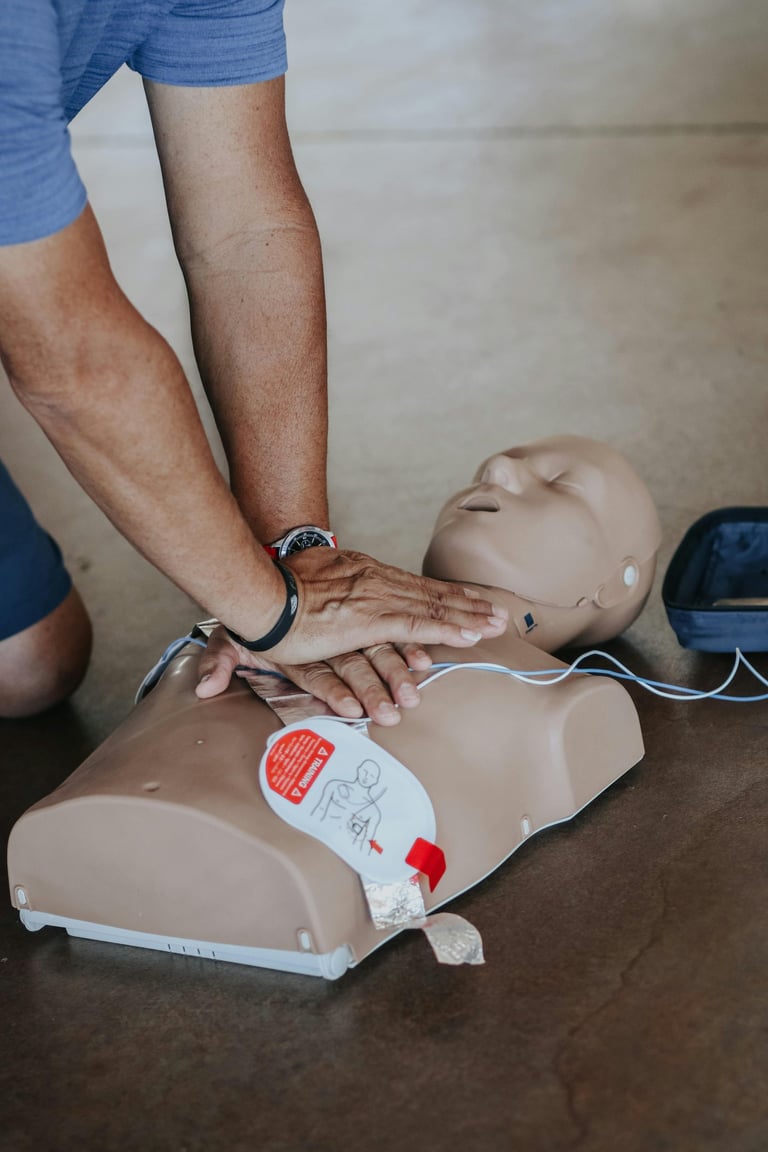
Sound Medical Skills is your go-to service for medical services. We offer various types of American Heart Association training as well as respirator fit testing.
Operating out of Bainbridge Island, Washington, and primarily serving Kitsap, Jefferson, and Clallam counties, please read more about our offerings.


BLS CPR Training
American Heart Association-certified Basic Life Support (BLS) certification designed for medical professionals. This includes full certification, shortened recertification, and skills-only testing options.
Heartsaver CPR
Heartsaver is a more condensed American Heart Association class designed for non-medical professionals and laypeople.
Respirator Fit Testing
The Occupational Safety and Health Administration (OSHA) requires users and workers in certain industries to pass a respirator fit test to confirm proper fit and a tight seal against the user's face. We offer qualitative fit testing certification.
FAQ
Q: What is the difference between AHA BLS and Heartsaver certification?
BLS (Basic Life Support)
BLS is professional-grade certification. It's designed for healthcare providers — nurses, EMTs, medical assistants, dental hygienists, and anyone whose job requires them to respond to cardiac or respiratory emergencies as part of their clinical role. The course covers single-rescuer and team-based CPR, bag-mask ventilation (BVM), AED use, and relief of choking in adults, children, and infants. It assumes you may be working alongside other trained providers and emphasizes things like team dynamics and high-performance CPR. Recertification is required every two years, and most healthcare employers mandate it.
Class time: roughly 4 hours
Heartsaver
Heartsaver is the public-facing, lay-rescuer certification. It's built for people who aren't healthcare providers but want — or are required — to know CPR: teachers, coaches, workplace safety officers, childcare workers, fitness instructors, and so on. It covers the same core skills (CPR, AED, choking relief) but is structured around the scenario of a bystander responding alone until EMS arrives, rather than a clinical team environment. There are several Heartsaver variants (CPR AED, First Aid CPR AED, Pediatric First Aid, etc.) depending on the audience.
Class time: around 2-3 hours
Q: How does American Heart Association (AHA) CPR certification differ from Red Cross or other similar programs?
Here's how the major US CPR certification programs rank from most to least rigorous:
1. AHA BLS (Basic Life Support)
The gold standard for healthcare providers. Covers high-quality CPR for adults, children, and infants; 2-rescuer scenarios; bag-valve-mask ventilation; and AED use. Requires hands-on skills testing with a manikin. In Washington state,
2. AHA ACLS (Advanced Cardiovascular Life Support)
Technically a step above BLS, but it's a prerequisite-based advanced course rather than a standalone CPR program — requires current BLS. Covers rhythms, medications, and team dynamics in cardiac arrest.
3. AHA Heartsaver CPR/AED (with First Aid)
The full version is more rigorous than the basic. Designed for lay responders in workplace or community settings. Still requires a hands-on skills check.
4. Red Cross BLS / CPR-AED for Professional Rescuers
Very comparable to AHA BLS — covers multi-rescuer CPR, BVM use, and infant/child care. Slightly less dominant in clinical hiring but widely respected.
5. Red Cross CPR/AED for Adults, Children & Infants
The standard lay-rescuer course. Solid coverage but less clinically demanding than the professional rescuer track.
6. NSC (National Safety Council) CPR/AED
Comparable to Red Cross lay-rescuer level. Common in workplace safety contexts.
7. ASHI / MEDIC First Aid
Distributed through training centers; quality can vary by instructor. Generally on par with NSC/Red Cross lay-rescuer level.
8. Online-only / blended courses (Protrainings, CPR Select, etc.)
Convenience-focused. Skills assessment is self-directed or mailed-in, which reduces objective rigor. Some employers and healthcare settings don't accept these.